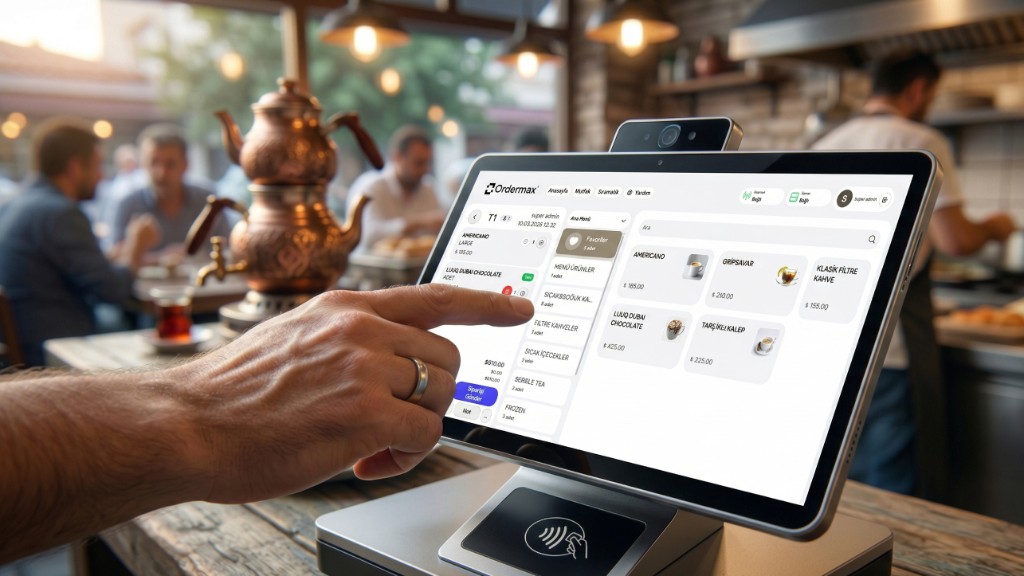
Why Turkey is a Unique POS Market
Turkey's restaurant technology market has grown significantly over the past five years, but it remains distinct from Western European or North American markets in several critical ways:
- Fiscal integration requirements: All point-of-sale transactions must be recorded through certified fiscal devices (ÖKC) and integrated with the Revenue Administration (GİB) for e-invoice compliance
- Data residency: KVKK (Turkey's data protection law) requires personal data to be stored on servers located in Turkey
- Payment ecosystem: Turkey has a unique mix of installment credit cards, local mobile payment apps, and cash that international POS systems often don't fully support
- Language and support: Restaurant staff typically requires full Turkish-language interfaces and local-language support
Key insight: A POS system that works perfectly in Germany or the US may be unusable in Turkey due to fiscal compliance gaps. Always verify local compliance before evaluating features.
Turkey-Specific Compliance Requirements
🇹🇷 Non-Negotiable Requirements for Turkey
E-Invoice (e-Fatura) Integration
Mandatory for businesses above GİB revenue thresholds. POS must generate and transmit compliant e-invoices automatically.
E-Archive (e-Arşiv) Support
Digital storage and retrieval of fiscal documents as required by Turkish Revenue Administration (GİB).
ÖKC (Fiscal Cash Register) Integration
Turkish law requires certified fiscal devices. POS must integrate with approved ÖKC hardware.
KVKK Compliance
Turkey's personal data protection law. Customer data must be stored in Turkey and handled per KVKK regulations.
Local Payment Methods
Installment credit cards (taksit), BKM Express, local mobile wallets and bank direct payment must be supported.
Core Feature Checklist for 2026
Beyond compliance, here are the features that matter most for Turkish restaurant operations:
Essential Features
- Table and order management
- Kitchen display system (KDS)
- Waiter mobile app
- Real-time inventory tracking
- Sales reporting and analytics
- QR menu and self-order
- Online order integration
- Multi-branch management
- Offline mode
- AI-powered stock suggestions
- Recipe-based cost tracking
- Loyalty program
Local vs International POS Software
| Criterion | Local (e.g., OrderMAX) | International |
|---|---|---|
| E-invoice compliance | ✅ Built-in | ⚠️ Often missing or add-on |
| ÖKC integration | ✅ Certified | ⚠️ Rarely supported |
| KVKK compliance | ✅ Turkey data residency | ⚠️ Data may be abroad |
| Turkish language UI | ✅ Native | ⚠️ Translation quality varies |
| Local payment methods | ✅ Full support | ⚠️ Limited installment support |
| Local support | ✅ Turkish phone/WhatsApp | ⚠️ English email only |
| Feature depth | ✅ Deep | ✅ Often deep |
| International integrations | ⚠️ Limited | ✅ Wide ecosystem |
How to Evaluate Restaurant POS Software in Turkey
Follow this evaluation framework before committing to any solution:
Step 1: Verify Compliance First
Ask specifically: Does it integrate with GİB for e-invoice? Is it ÖKC certified? Where is customer data stored? If any answer is unsatisfactory, move on. No amount of features compensates for a compliance gap.
Step 2: Match Features to Your Operation Type
A single-location café needs different features than a 10-branch fast food chain. Map your actual workflows to the feature set. Request a live demo specific to your operation type, not a generic product tour.
Step 3: Test Offline Performance
Internet outages happen. Turkey's infrastructure is generally good but not infallible. Test what happens to the system when connectivity drops. Offline mode should handle orders, payments, and sync seamlessly when connection returns.
Step 4: Evaluate Support Quality
Call the support line during a demo period. Check response time, language quality, and whether they understand restaurant operations. A 15-minute response guarantee with Turkish-speaking support is a meaningful differentiator.
Step 5: Understand Total Cost of Ownership
Monthly subscription is not the only cost. Factor in: hardware, installation, training, per-transaction fees, add-on module costs, and annual price escalation clauses.
Pricing Expectations for 2026
Restaurant POS pricing in Turkey typically follows one of three models:
- SaaS subscription: Monthly or annual fee covering software access and updates. Most common model. Typically cloud-based.
- License + maintenance: One-time license with annual maintenance fee. Less common, usually for on-premise solutions.
- Hardware bundle: Software cost embedded in hardware sale. Often seen with ÖKC-integrated solutions.
For a single-location restaurant in Turkey, expect monthly SaaS costs to range widely depending on module selection. Pricing transparency is limited in the market; most vendors require contact for quotes. OrderMAX offers Cloud and Pro packages with teklif-based pricing aligned to business size.
Tip: Always ask about implementation and training costs separately. The subscription fee rarely includes them.
About OrderMAX
OrderMAX is a restaurant POS and automation platform developed in Turkey for the Turkish market. It covers all local compliance requirements natively: e-invoice integration, ÖKC support, KVKK-compliant data storage, and full Turkish-language operation. The platform serves restaurants, cafes, markets, fast food chains, and multi-branch enterprises.
See OrderMAX in Action
Request a demo tailored to your restaurant type and operation scale.
View POS System Details